A thesis conducted by Victoria Caballero, who holds a master’s degree in meteorology and climatology from the University of Chile, and supervised by CR2 (Center for Climate and Resilience Research) researcher Roberto Rondanelli, indicates that the greatest number of tornadoes in Chile occurs between mid-May and mid-June.
In Chile, tornadoes and waterspouts are rare extreme weather events. In fact, until the tornado outbreak of May 2019, they were considered virtually nonexistent in the country, despite several studies pointing to the possibility of tornadoes occurring in the south-central zone. Today, there is a compiled record of tornadoes and waterspouts in Chile dating from 1554 to the present. This record shows an apparent seasonality, with most events occurring between the second half of May and the first half of June. It also shows a significant presence of these phenomena in the south-central region of Chile, according to the study “Seasonality of Environments Favorable for Tornado Formation in South-Central Chile.”
Atmospheric Instability
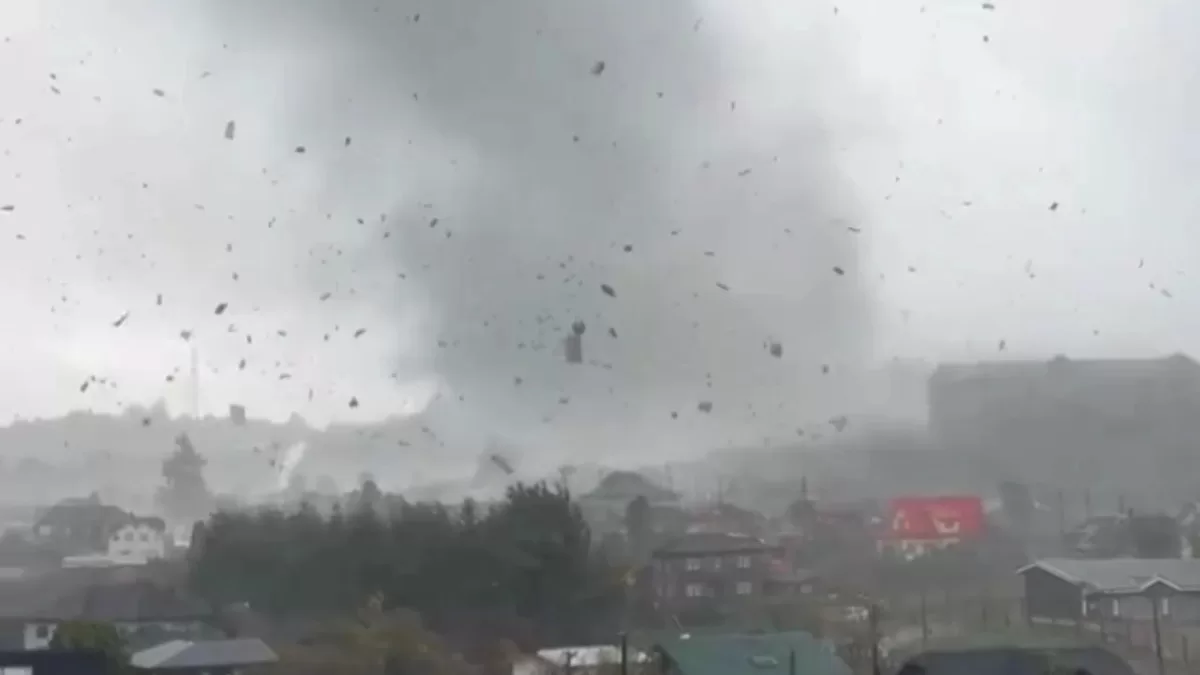
This study was led by Roberto Rondanelli, CR2 researcher and professor at the University of Chile, who explains that severe storms give rise to tornadoes like the one that occurred on Sunday, May 25, in Puerto Varas. These storms are caused by atmospheric instability, meaning that the air near the surface is lighter than the air above it. This leads to upward movement of air and the formation of cumulonimbus clouds, which resemble cotton towers and can reach heights of 10 kilometers or more. These storm clouds can produce hail, lightning, and tornadoes under specific conditions.
Wind Shear
The thesis led to a recently published paper in Geophysical Research Letters, which notes that the regime in south-central Chile is favorable for tornado formation during the fall-winter period, specifically from May to August. This period is characterized by strong northwesterly low-level wind shear and cooling at higher altitudes, which increases atmospheric instability. Together, these factors create the conditions for vertical vorticity formation near the surface. The study “Climatological Aspects of Notable Tornado Events in Chile” also supports the idea that tornadoes tend to occur during a specific time of year.
Wind shear refers to the rapid change in wind speed and/or direction with height, and it is one of the ideal atmospheric conditions for tornado formation. According to Rondanelli, this means the wind changes very quickly between 500 and 1,000 meters above the ground.
These atmospheric conditions were not widely understood before the tornadoes that struck Concepción and Los Ángeles in May 2019. However, there is now a better understanding of the phenomenon and of the specific seasonal conditions that foster tornado formation. These conditions match exactly with the timing of the Puerto Varas tornado in 2025, as well as past events like those in Concepción in 2019 and in 1934.
Tornado Memory
According to Roberto Rondanelli, Chile has traditionally been skeptical about the occurrence of tornadoes. However, there is evidence of their existence dating back to ancient times, along with Indigenous peoples’ cultural understanding of such phenomena. In particular, the Mapuche people recognize the Meulen, a malevolent spirit they associate with tornadoes, and have developed ways to respond to these events. The Mapuche have observed the rotational direction of tornadoes and know how to react when one appears.
As for the future frequency of tornadoes, the CR2 researcher notes that it is still unknown whether climate change will make them more frequent or intense.
To protect ourselves from tornadoes—especially in the absence of monitoring radar systems—it is important to educate the public. Currently, there is a significant lack of protection and awareness, with no early warning systems or radar network in place. Rondanelli recommends consulting the information available from SENAPRED (Chile’s National Disaster Prevention and Response Service).