
- While scientists in the United States struggle daily to prevent decades of scientific data from being lost, in Chile, the Center for Climate and Resilience Research (CR2) has just launched a portal featuring in-house platforms and climate data collected throughout its operation as a FONDAP ANID Center.
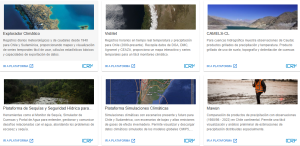
- Estimates of precipitation, temperature, land use, drought, and water security, among others, are now available in this repository called DataClima.
According to a recent article published by BBC News, a large amount of scientific data is being deleted from U.S. government websites, jeopardizing decades of research on issues such as health, climate change, and extreme weather events.
In Chile, meanwhile, the efforts of researchers at the FONDAP ANID CR2 Center have resulted in a new digital repository called DataClima.
This platform brings together more than 20 compiled and/or pre-existing climate service platforms, along with databases containing information collected by CR2 members themselves. The goal is to provide evidence-based information for academics, decision-makers, and civil society.
“We realized that there was a lot of valuable information developed by our researchers, but it wasn’t well-structured. So, DataClima was created as a platform that includes an inventory and metadata records for all of our existing platforms and databases,” explains Francisca Muñoz, Head of Data and Computing at CR2, who has led this area since around 2013–2014.
Climate Metadata
One of the main features of this new scientific repository is that users can filter searches by geographic domain, topic, and time range. It also includes paleoclimate data and future projections. All of this can be accessed with the help of a chatbot that answers queries and provides recommendations on related platforms and databases.
“This multi-platform project, which initially started as a service for CR2 researchers, now stands as a climate information service available to anyone interested in accessing data on Chile’s climate,” says René Garreaud, Deputy Director of CR2 and Full Professor at the Department of Geophysics at the Faculty of Physical and Mathematical Sciences, University of Chile.
Indexing System and Filters in DataClima
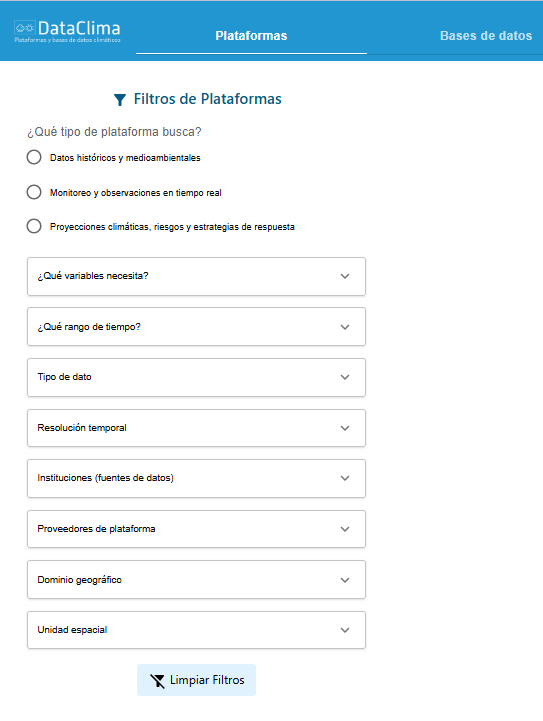 How does the “Platforms” section of DataClima work? It uses an indexing and filtering system that selects different metadata fields, thereby facilitating the search and evaluation of platforms based on specific characteristics or requirements. The results are presented in three formats: graphical cards, text-based list, and a table with all metadata.
Additionally, there is a section for databases where users can view general information such as format, description, DOI, the platforms fed by that database, and the principal investigator in charge, among other details.
Currently, the climate metadata section in DataClima has been structured to make the search and access to relevant data easier. These efforts align with the FAIR data principles, recently promoted at the national level through the “Strategy Proposal for Implementing a FAIR Data Policy in Chile,” which supports the standardization and potential reuse of the compiled data.
Available Platforms
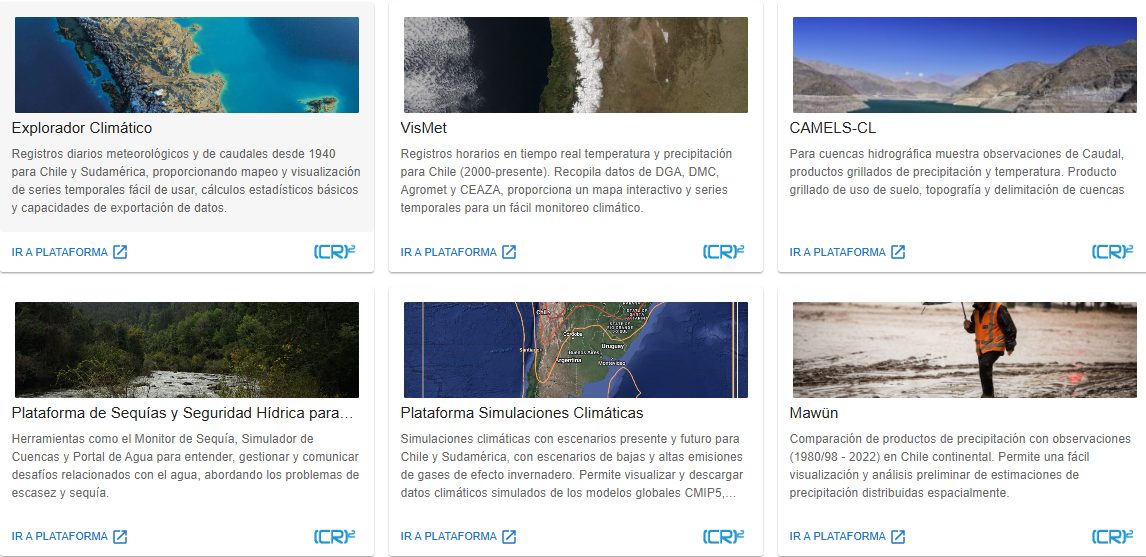
CR2 Deputy Director René Garreaud shares that the first platform developed at the Center, predating DataClima, was the “Climate Explorer.” According to the researcher, the Climate Explorer remains a “best-seller.” “There, you can view historical and current climate data, including precipitation, temperature, streamflow, etc.,” says Garreaud.
As of today, the platforms available on DataClima and their uses are the following. (Click to explore)